
Integrated Campaign Management in the Digital Age
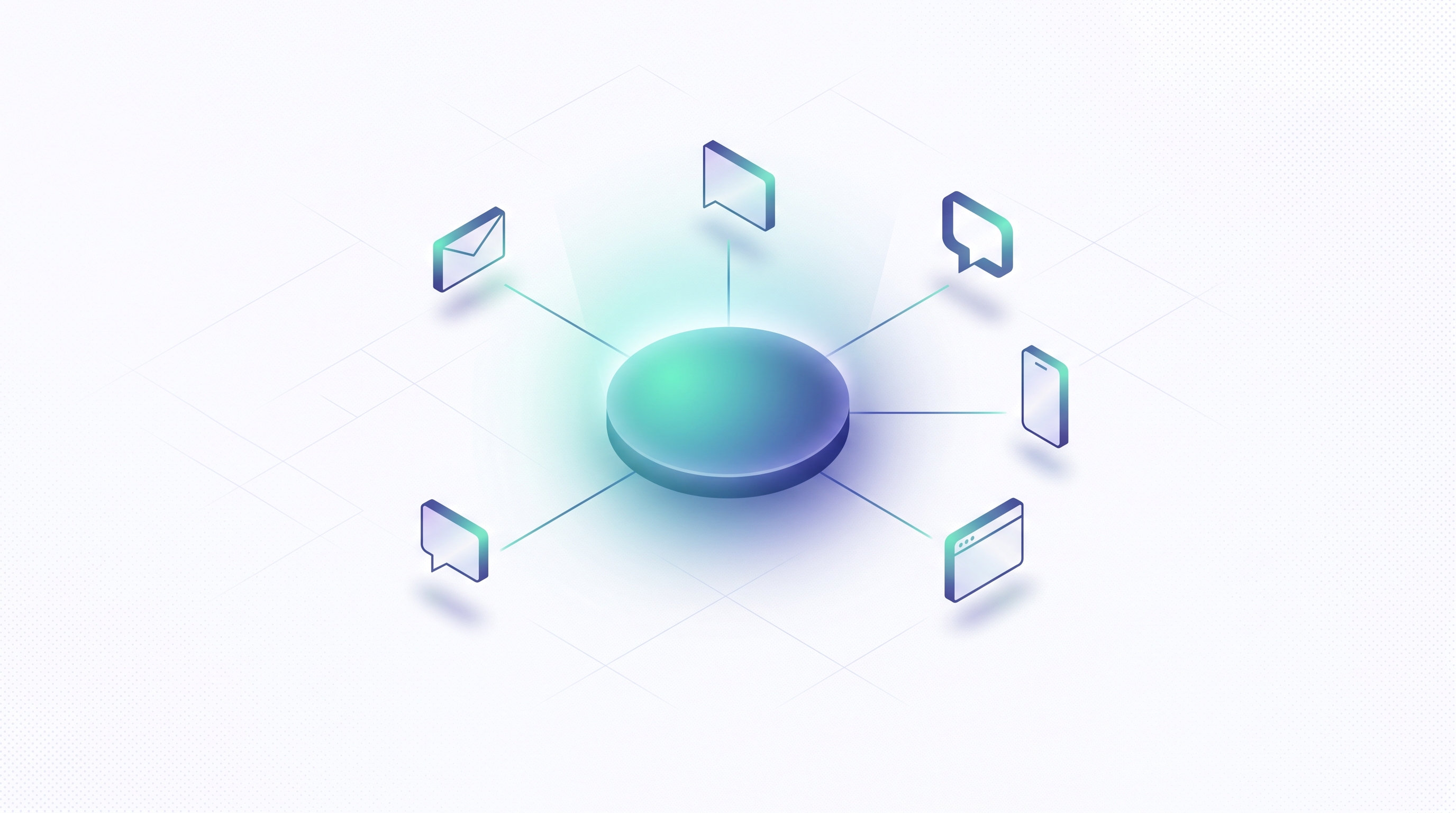
A multi-channel marketing strategy reaches customers across several platforms — email, social, paid ads, events, and more — with campaigns that are planned together instead of built separately in each channel's own tool. Done well, it means a customer sees one consistent message wherever they encounter your brand, instead of a different, disconnected pitch on every platform.
The stakes are higher than they used to be. McKinsey's research on omnichannel marketing found that customers who buy across multiple channels shop roughly 1.7 times more than customers who stick to a single channel. Reaching people in more places, consistently, is not a nice-to-have — it measurably changes how much they buy.
What Multi-Channel Marketing Really Means
It helps to separate two terms that get used interchangeably. Multi-channel marketing means running campaigns across several channels — email, social, paid ads, events — often planned and tracked somewhat independently. Gartner's marketing glossary frames the more advanced version, omnichannel marketing, as channels working together around one continuous customer journey, powered by unified data, rather than each channel just broadcasting its own version of the same message.
The practical takeaway: multi-channel is about presence in more than one place. Omnichannel is about those places working together. Most teams start at multi-channel and grow toward omnichannel as their data and tooling mature — and the biggest single blocker on that path is almost always disconnected data, not a lack of channels.
Why It Matters Now
Customers do not experience your brand one channel at a time. They see an ad, then a social post, then an email, often within the same day — and they expect those touches to feel like one conversation, not three unrelated interruptions.
Beyond the McKinsey figure above, the pattern holds across industries: brands that show up consistently across channels tend to earn more trust and more repeat business than brands that treat each channel as its own silo. The channels themselves are not the differentiator anymore — most competitors are on the same platforms. Coordination is.
Key Components of a Multi-Channel Strategy
A real multi-channel strategy rests on a handful of pieces working together, not any single tool.
One Place to Plan Every Channel
Campaigns need a shared home — a place where email, social, paid ads, and events for a single launch live on one timeline instead of five disconnected calendars. HeadshotMarketing is built around exactly this: a visual campaign designer with a lane for each channel, shared scheduling, and a common asset library, so a launch gets planned once instead of stitched together across separate tools.
A CRM That Every Channel Feeds
Multi-channel only pays off if every channel's activity lands in one customer record. HeadshotMarketing's CRM is designed to hold a unified contact database, with lead scoring and a pipeline that tracks deals across stages — so a contact who clicked an ad, opened an email, and registered for a webinar is recognized as one person, not three separate leads in three separate systems.
A Shared Content Library
Consistent messaging across channels requires a single source of truth for creative and copy. A centralized content library with status controls and brand-asset governance means the version of an asset that goes into an email matches the version that goes into a social post — instead of a slightly different file drifting into each channel over time.
Marketing Automation Benefits — Used Where They Actually Help
Automation is often oversold as a magic fix, but its real value is narrow and specific: it removes the manual work of sending the right message at the right moment across channels, so a team can run more journeys without more headcount. HeadshotMarketing's automation tooling is still developing toward that vision — the interface exists today, and the underlying engine that runs full cross-channel journeys is one of our active roadmap items. We are noting that plainly here rather than overstating where automation already stands.
Developing a Successful Campaign Plan
Before opening any tool, a multi-channel campaign needs a plan. A few steps make the difference between a coordinated launch and five disconnected pushes:
- Set one clear objective. Awareness, leads, or revenue — pick one primary goal per campaign so every channel is working toward the same outcome.
- Segment the audience before choosing channels. Different segments respond to different channels; know who you are reaching before deciding where.
- Choose channels based on where your audience actually is, not based on which channels are easiest to set up.
- Allocate budget by expected contribution, not by habit. Last year's split is not automatically this year's right answer.
An audience-first approach also pays off practically: defining a segment once — as a reusable, criteria-based asset with an estimated reach — means it can be pointed at an ad campaign or a broader marketing campaign without rebuilding the same targeting logic in every tool.
The Role of Data and Analytics
A multi-channel strategy without measurement is just five separate guesses running at once. Real-time dashboards that span every channel let a team see performance as campaigns run, not weeks later in a quarterly report. HeadshotMarketing is built to track per-channel and per-campaign performance — revenue, ROAS, and conversion — in one place, so a marketing lead can see how paid, social, and email each contributed to a single launch rather than reconciling five separate exports by hand.
Full multi-touch attribution, which weighs how much credit each individual touchpoint deserves along a customer's path to purchase, is a deeper capability that most platforms — including HeadshotMarketing — are still building out. What is available today is the unified contact timeline that any future attribution model would need: every channel's activity against one customer record, in one place, ready to be analyzed together instead of scattered across disconnected systems.
Case Examples: What Coordinated Campaigns Look Like in Practice
Consider a product launch that has to land the same week across email, social, paid ads, and a webinar. Planned separately, five people build five slightly different timelines, and keeping them in sync becomes a manual scramble that eats the week before launch.
Planned on a shared canvas instead, the campaign gets laid out with a lane per channel against one timeline, pulling assets from one shared library. Cross-channel orchestration keeps the launch consistent, and performance tracking rolls up to one view instead of five. This is an illustrative scenario describing the workflow HeadshotMarketing is built to support — not a customer case study.
The same pattern applies to social specifically: a single content calendar plans and schedules posts across every connected network, with post-level engagement visible in one place, so a social manager reviews the month without tab-hopping between five native apps. Direct, automatic delivery to each social network is part of our roadmap; today, a scheduled post is marked ready to publish rather than pushed live automatically, and we think that distinction is worth being upfront about.
Challenges and Solutions in Multi-Channel Marketing
Even a well-planned multi-channel strategy runs into predictable friction:
- Channel integration. Each new channel is another system to connect. The fix is picking a platform where channels share data by design, rather than adding integrations one at a time.
- Consistent messaging. Without a shared content library, every channel drifts toward its own version of the message. A single, governed source of assets keeps that from happening.
- Data management. More channels mean more data, and it is only useful if it lands in one place. A unified customer record turns scattered activity into a single, usable view.
- Keeping pace with change. Platforms change their rules constantly. Building around owned data — your contact records, your content library — rather than any single channel's quirks makes a strategy more durable when a platform changes overnight.
Future of Multi-Channel Marketing
A few directions are already visible. AI is taking over more of the repetitive work — drafting first-pass content, summarizing performance, spotting patterns across channels — while strategic decisions stay with people. Privacy rules keep tightening, which pushes teams toward first-party data collected directly through owned channels rather than third-party tracking that is disappearing across the industry. And influencer and creator partnerships are becoming a standard channel in the mix rather than a specialty add-on handled outside the main marketing stack.
The throughline across all of it: the strategies that hold up are the ones built on owned, unified data — not the ones dependent on any single platform's current rules. That is the bet behind treating every channel as one system instead of a collection of separate tools glued together after the fact.
FAQ: Multi-Channel Marketing Strategy
What are the benefits of a multi-channel marketing strategy?
It increases the number of places customers can find and engage with a brand, and — done with consistent messaging — it tends to build more trust and repeat engagement than a single-channel approach. It also gives a team more surface area to learn what resonates with different audience segments.
How does marketing automation fit into a multi-channel strategy?
Automation's real value is sending the right message at the right moment across channels without manual, one-by-one sends. It is a tool for scaling coordinated follow-up, not a replacement for planning the strategy itself.
Why does a shared CRM matter for multi-channel campaigns?
Without one, the same customer can look like three different leads across three different channels. A shared CRM keeps every channel's activity tied to one customer record, which is what makes coordinated, non-repetitive messaging possible.
What is the biggest challenge in multi-channel marketing?
Disconnected data. Most of the visible problems — inconsistent messaging, siloed reporting, duplicate leads — trace back to channels that do not share a common customer record.
What is the difference between multi-channel and omnichannel marketing?
Multi-channel means being present across several channels. Omnichannel means those channels are coordinated around one continuous, data-driven customer journey. Most teams grow from one toward the other as their systems and data mature.
How can AI improve a multi-channel strategy?
AI speeds up the research and drafting work behind content for each channel and can surface patterns across channels faster than manual analysis — for example, which combination of touches tends to precede a conversion. It supports the strategy; it does not replace the planning and judgment behind it.
Run Every Channel From One Command Center
HeadshotMarketing is being built as a single platform for multi-channel campaigns, CRM, content, and analytics — so coordinating email, social, paid ads, and events does not mean stitching together five separate tools. Explore the platform's features, browse real-world use cases, or sign up for HeadshotMarketing to get started.