
Where can I see which AI generations my team ran, and the tokens and cost each one used?
In HeadshotMarketing, you can track your team's AI runs, token consumption, and expenses inside Content → AI Tools.
About this answer — Produced by our own assistant on 23 September 2026 from our published documentation. The pages it drew on are linked under the answer. It is generated text, not a statement from a person — where it and a linked page disagree, the page is right.
Answer
In HeadshotMarketing[1], you can track your team's AI runs, token consumption, and expenses inside Content → AI Tools.
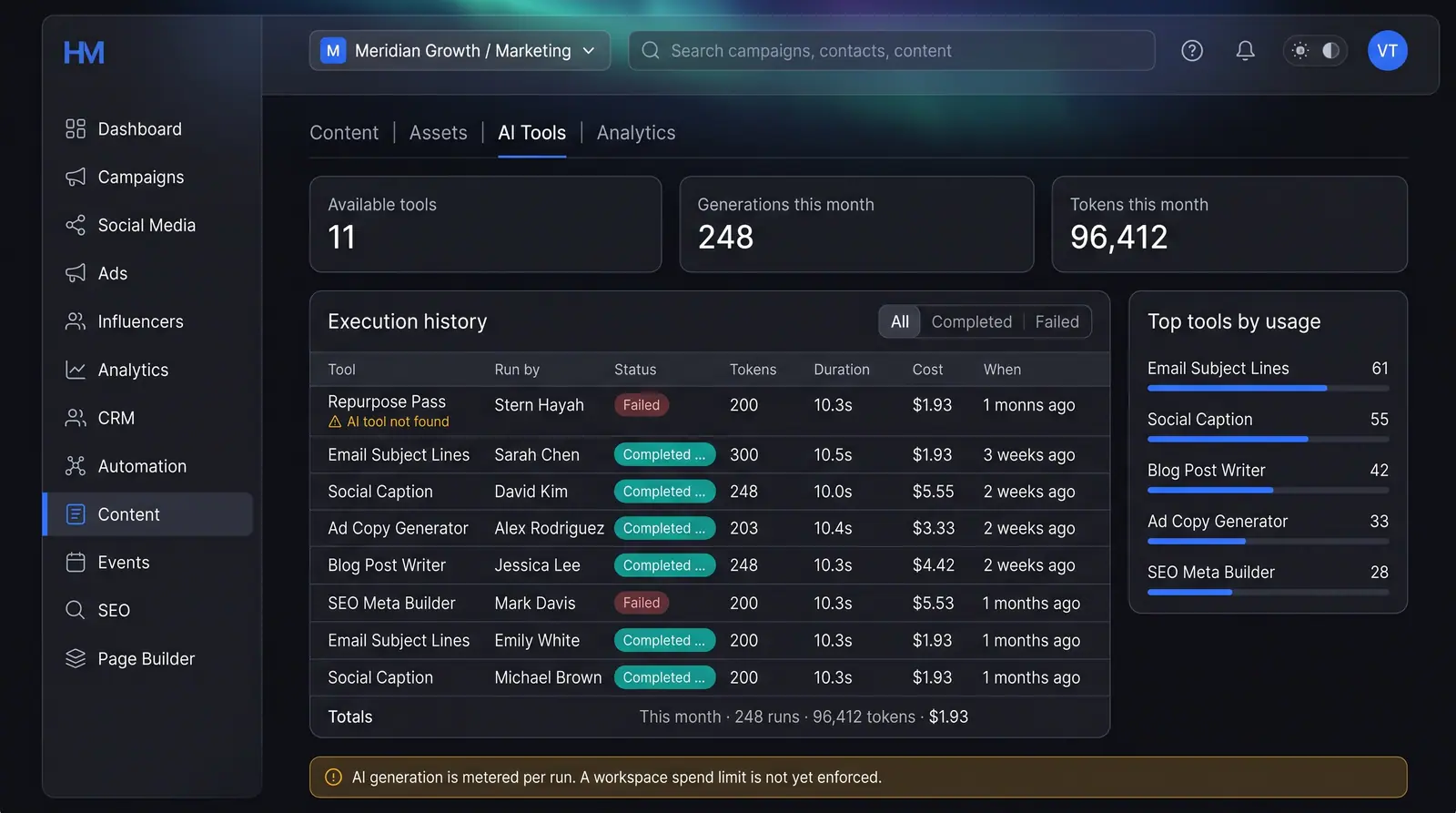
At the top of the AI console, three summary cards show workspace-level metrics for the current calendar month: available tools, total generations, and tokens consumed.
The full breakdown is tracked in the AI Usage Ledger, as illustrated on the AI Content Tools and Usage Ledger concept[2] page:
- Execution history table: Lists every run with the specific tool used, the team member who ran it, execution status (Completed or Failed, with failure reasons), tokens used, duration, cost, and timestamp.
- Filters & monthly totals: Filter runs by completed or failed status and review a totals row summarizing monthly runs, token counts, and spend.
- Top tools ranking: View a ranked panel of the most-used generators across your workspace.
 (opens in a new tab)
Illustration of the concept, not a screenshot of the actual product — AI Content Tools and Usage Ledger[2]
(opens in a new tab)
Illustration of the concept, not a screenshot of the actual product — AI Content Tools and Usage Ledger[2]
For immediate feedback, the footer of the generation panel displays the exact duration and token count right after you run a prompt. In addition, drafts saved to your content library retain metadata and an ai-generated tag so you can trace finished assets back to their original run.
To see how metered AI governance fits into your workflow, explore the Metered AI Content Spend use case[3] or check out AI Content Tools and Generation[4].
Sources
The pages this answer was drawn from.
- Marketing & Sales Command Center | HeadshotMarketingheadshotmarketing.com(opens in a new tab)
- AI Content Tools and Usage Ledger — Concept | HeadshotMarketingheadshotmarketing.com(opens in a new tab)
- See exactly what your AI usage cost — Use Cases | HeadshotMarketingheadshotmarketing.com(opens in a new tab)
- Spin up on-brand content with a library of AI tools — Use Cases | HeadshotMarketingheadshotmarketing.com(opens in a new tab)